Teaching is not just a profession—it is a quiet responsibility that shapes human consciousness. In India, the idea of a teacher goes far beyond textbooks. The word Guru itself carries a deep meaning: the one who removes darkness. That is why understanding the 7 qualities of a good teacher becomes so important. A good teacher doesn’t just transfer information; they awaken something within the student.
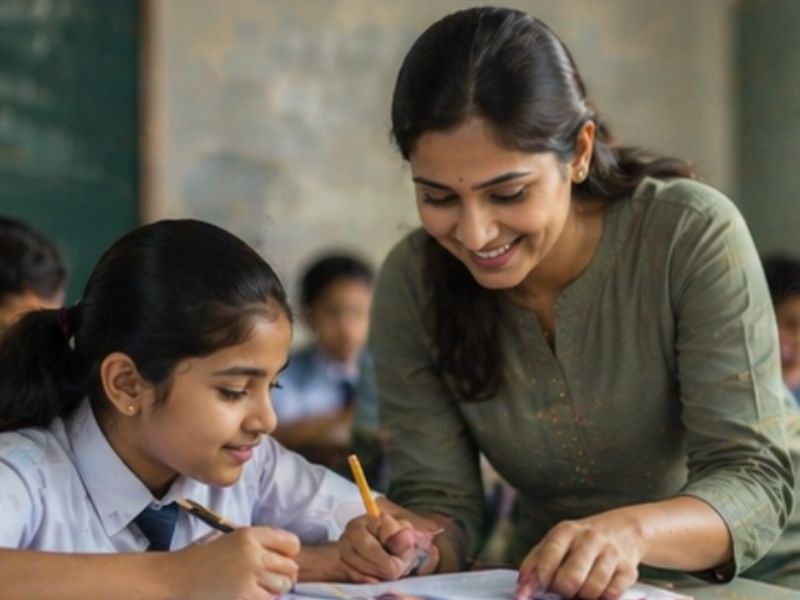
Today, when education is often reduced to marks and competition, it becomes even more important to reflect on the 7 qualities of a good teacher that truly matter. Not just effective, not just knowledgeable—but transformative.
Let’s explore seven deeper, less-talked-about qualities of a good teacher from a philosophical and spiritual lens, in a simple and relatable way.
A Teacher Who Sees Potential, Not Just Performance

Most people judge students based on marks, ranks, or behavior. But a good teacher sees beyond all that. They see what a student can become, not just what they are today.
Every child carries a hidden possibility. Some are expressive, some are silent. Some learn fast, others take time. A true teacher understands that growth is not a race—it is a journey.
Instead of labeling a student as “weak” or “average,” a good teacher asks:
- What is this child naturally good at?
- What is holding them back?
- How can I help them discover their own strength?
This quality requires patience and belief. It’s like planting a seed without constantly digging it up to check if it’s growing.
The Ability to Create Inner Curiosity

A great teacher doesn’t just give answers—they ignite questions.
In many classrooms, students are trained to memorize. But real learning begins when a student starts wondering:
- Why does this happen?
- What if this was different?
- How does this connect to my life?
Curiosity is the foundation of wisdom. A good teacher understands this and creates an environment where asking questions is not seen as disrespect, but as intelligence.
Instead of saying, “Just learn this,” they say:
“Think about it… what do you feel?”
This small shift transforms education from pressure into exploration.
Emotional Awareness and Sensitivity

Teaching is not only about the mind—it is deeply connected to emotions.
Students come into the classroom carrying invisible burdens:
- Family problems
- Self-doubt
- Fear of failure
- Social pressure
A good teacher senses these unspoken emotions. They may not always solve them, but they acknowledge them.
Sometimes, a kind word from a teacher stays in a student’s heart for years. Similarly, one harsh statement can break confidence.
Emotional awareness means:
- Knowing when to push and when to pause
- Understanding that every student has a different emotional capacity
- Responding with empathy instead of anger
In a way, a teacher becomes a silent guide for emotional growth.
The Courage to Be Imperfect

This might sound unusual, but a good teacher is not someone who pretends to know everything.
In fact, one of the most powerful qualities is the courage to say:
“I don’t know… let’s find out together.”
This honesty builds trust. It shows students that learning is a continuous process, not a fixed state.
When teachers accept their own imperfections:
- Students feel less pressure to be perfect
- The classroom becomes more human
- Mistakes become part of learning, not something to fear
A teacher who is real, relatable, and humble leaves a deeper impact than one who only appears authoritative.
The Ability to Connect Knowledge with Life

One of the biggest gaps in education today is this: students learn concepts, but don’t understand their relevance.
A good teacher bridges this gap.
They connect lessons with real life:
- Mathematics with daily decisions
- Science with nature
- Literature with human emotions
- Philosophy with personal choices
When students see how knowledge applies to their own life, learning becomes meaningful.
For example, instead of just teaching a formula, a teacher might explain:
“How can this help you think better or solve real problems?”
This makes education practical, not just theoretical.
Inner Calmness and Presence
This is a deeply spiritual quality, often overlooked.
A teacher’s presence affects the entire classroom. If the teacher is anxious, angry, or distracted, students feel it immediately.
But when a teacher carries calmness within:
- The classroom feels safe
- Students become more focused
- Learning becomes smoother
Inner calmness doesn’t mean being silent or strict. It means being centered.
Such teachers don’t react instantly. They respond thoughtfully. Even in chaos, they carry a sense of balance.
In Indian philosophy, this is similar to the idea of sthita prajna—a stable and steady mind.
Students may not understand this intellectually, but they feel it deeply.
The Intention to Serve, Not Just Teach
At the deepest level, teaching is an act of service.
A good teacher is not driven only by salary, syllabus, or results. There is a deeper intention:
“To contribute to someone’s life.”
This doesn’t mean sacrificing everything. It simply means teaching with sincerity and purpose.
When intention is pure:
- Effort becomes natural
- Students feel valued
- Teaching becomes fulfilling
Such teachers don’t just finish chapters—they shape lives.
They understand that their words, actions, and attitude can influence a student’s future in ways they may never fully see.
Why These Qualities Matter More Than Ever
In today’s fast-changing world, information is easily available. Students can learn facts from the internet, videos, or apps.
But what they cannot easily find is:
- Guidance
- Understanding
- Inspiration
- Emotional support
This is where a good teacher becomes irreplaceable.
The role of a teacher is shifting from “information provider” to “consciousness awakener.”
And for that, these deeper qualities matter more than ever.
The Silent Impact of a Good Teacher
Think about your own life.
You may not remember every lesson, but you probably remember:
- A teacher who believed in you
- A moment when someone encouraged you
- A time when you felt understood
That is the real impact of a good teacher.
It is not always visible in marksheets or certificates. It shows up in confidence, choices, and character.
A good teacher doesn’t just prepare students for exams—they prepare them for life.
Final Thoughts: Teaching as a Path of Growth
Being a good teacher is not about achieving perfection. It is about growing continuously—just like students.
Every class, every interaction, every challenge becomes an opportunity to:
- Understand people better
- Reflect on oneself
- Improve with time
In a philosophical sense, teaching is a two-way journey. While teachers guide students, students also shape teachers.
And perhaps that is the beauty of it.
A good teacher is not just someone who teaches well.
They are someone who lives what they teach.
Quick Recap of the 7 Qualities of a Good Teacher
- Seeing potential beyond performance
- Creating curiosity instead of pressure
- Being emotionally aware and sensitive
- Accepting imperfections with honesty
- Connecting knowledge with real life
- Maintaining inner calmness and presence
- Teaching with the intention to serve
FAQs on 7 Qualities of a Good Teacher
Q1. What are the 7 qualities of a good teacher?
The seven deeper qualities of a good teacher go beyond basic teaching skills. They include:
- Seeing a student’s potential instead of judging performance
- Creating curiosity rather than forcing memorization
- Being emotionally aware and understanding
- Accepting their own imperfections with honesty
- Connecting knowledge with real-life situations
- Maintaining inner calmness and balance
- Teaching with a genuine intention to serve
These qualities make a teacher not just informative, but transformative.
Q2. What are the 12 qualities of a teacher?
Along with the core qualities, a well-rounded teacher may also have:
- Patience
- Strong communication skills
- Adaptability
- Creativity in teaching methods
- Discipline with flexibility
- Empathy
- Passion for learning
- Good listening skills
- Leadership ability
- Positive attitude
- Time management
- Continuous self-improvement
Together, these qualities help teachers connect better with students and create meaningful learning experiences.
Q3. What are 5 good sentences on teacher?
- A teacher is someone who guides us not only in studies but also in life.
- A good teacher inspires students to think and grow.
- Teachers help us discover our hidden potential.
- A teacher’s words can shape a student’s future.
- A true teacher teaches from the heart, not just from books.
Q4. What are the 5 qualities of a good teacher?
Five essential qualities of a good teacher are:
- Patience while dealing with different types of students
- Clear communication for better understanding
- Empathy towards students’ emotions
- Passion for teaching and learning
- Ability to motivate and inspire
These qualities create a positive and effective classroom environment.
Q5. Qualities of a good teacher paragraph?
A good teacher is someone who understands that every student is unique and learns differently. They are patient, kind, and supportive, creating a safe space where students feel comfortable expressing themselves. A teacher not only shares knowledge but also builds confidence and curiosity in students. They connect lessons with real life, making learning meaningful and practical. Most importantly, a good teacher teaches with sincerity and helps students grow not just academically, but emotionally and personally.
Q6. 7 qualities of a good teacher essay?
An essay on the seven qualities of a good teacher highlights the deeper role of teaching in shaping lives. A good teacher sees potential in every student, encourages curiosity, and understands emotions. They accept their own limitations and keep learning. They make lessons relatable by connecting them with real life. Their calm and balanced nature creates a peaceful learning environment. Above all, they teach with a purpose—to guide and uplift students. These qualities together make teaching a meaningful and impactful journey.
Q7. What are 5 simple sentences?
- A teacher helps us learn new things.
- Good teachers are kind and patient.
- They explain lessons clearly.
- Teachers encourage us to do our best.
- They help us become better people.
Q8. What makes a very good teacher?
A very good teacher is someone who connects with students on both intellectual and emotional levels. They understand that teaching is not just about completing the syllabus but about shaping minds. Their ability to listen, adapt, and inspire makes them stand out. They create a space where students feel valued and motivated to learn. Their presence itself encourages growth.
Q9. What makes a successful teacher?
A successful teacher is one whose students not only perform well academically but also grow as confident and responsible individuals. Success in teaching comes from consistency, dedication, and a genuine care for students. It also depends on the teacher’s willingness to keep learning and improving. A successful teacher measures achievement not just in marks, but in the overall development of students.
Q10. What are the 5 smart goals for teachers?
SMART goals help teachers stay focused and effective. Five examples are:
- Specific: Improve student participation by using interactive methods in class
- Measurable: Increase class test scores by a certain percentage
- Achievable: Introduce one new teaching strategy every month
- Relevant: Focus on improving weak areas of students
- Time-bound: Complete syllabus revision one month before exams
These goals help teachers stay organized and continuously improve their teaching approach
188v bet có tính năng “tự khóa tài khoản” – hỗ trợ người chơi muốn tạm nghỉ hoặc kiểm soát hành vi cá cược. TONY05-15