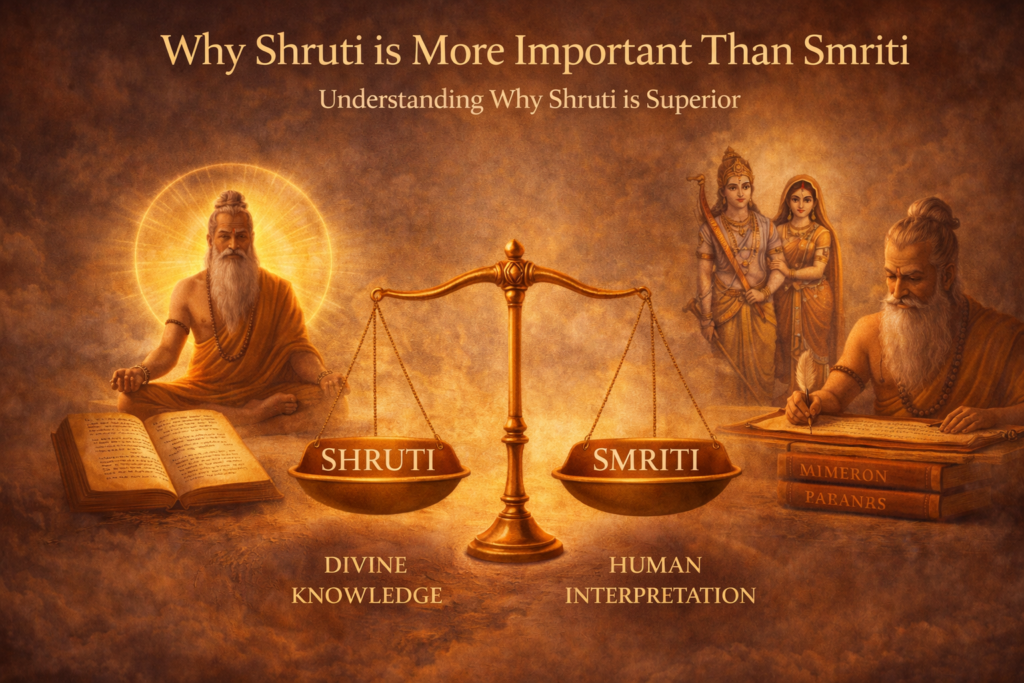
Understanding the difference between shruti and smriti is essential for anyone exploring Hindu philosophy, scriptures, and traditional knowledge. While both form the foundation of Hindu thought, they are not equal in authority or significance.
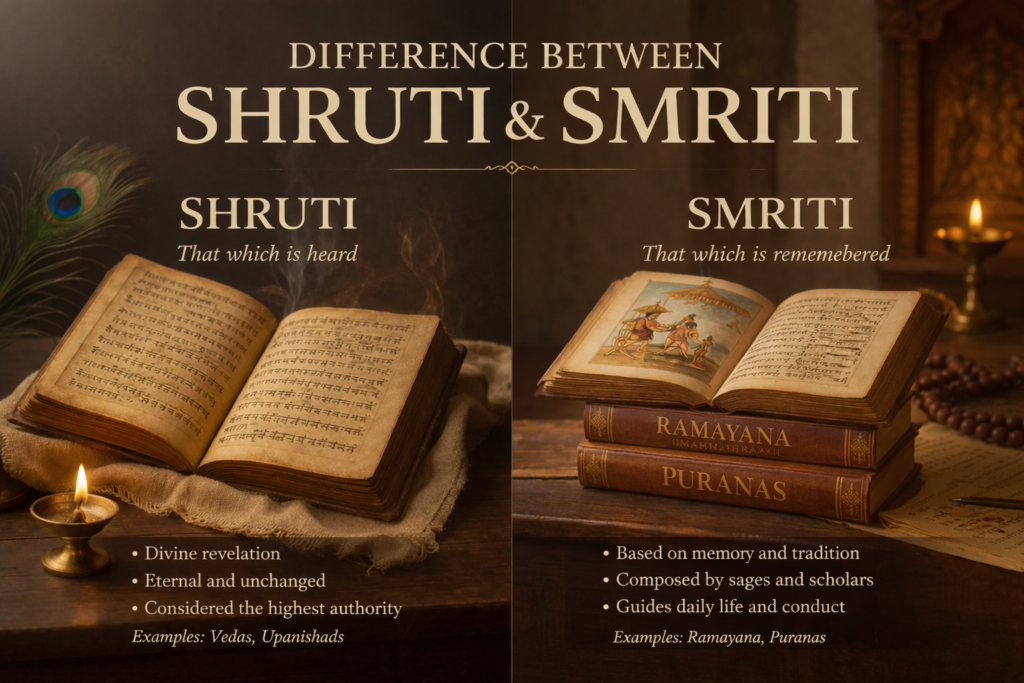
In this detailed guide, we will explore what is shruti and smriti, their meaning, examples, and most importantly—why Shruti is considered superior due to its divine origin and philosophical depth, while Smriti is seen as interpretation and social guidance.
What is Shruti? Divine Knowledge and Ultimate Truth
The term Shruti means “that which is heard.” It refers to sacred knowledge that was directly revealed to ancient sages (rishis) through deep spiritual realization.
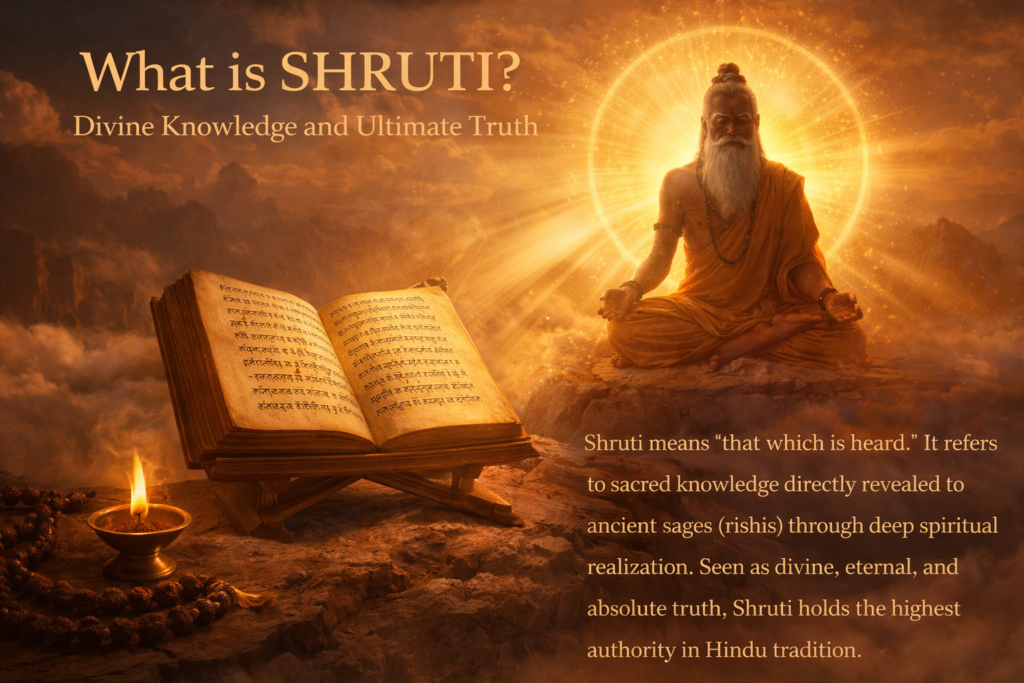
Shruti is not created by humans. It is considered divine, eternal, and absolute truth. This is why Shruti holds the highest authority in Hindu tradition.
Why Shruti is Supreme
Shruti is regarded as more important because:
- It is divinely revealed, not written by humans
- It represents pure philosophy and universal truth
- It is free from human error or bias
- It explains the ultimate reality (Brahman) and the nature of existence
Shruti is not about rules—it is about truth itself.
Examples of Shruti Texts
The most important Shruti texts include:
- Vedas
- Rigveda
- Yajurveda
- Samaveda
- Atharvaveda
- Upanishads
These texts focus on deep philosophical questions like:
- What is the ultimate reality?
- What is the conciosnes (Atman)?
- What is the purpose of life?
What is Smriti? Interpretation and Social Framework
The word Smriti means “that which is remembered.” Unlike Shruti, Smriti texts are written by humans based on their understanding of Shruti.
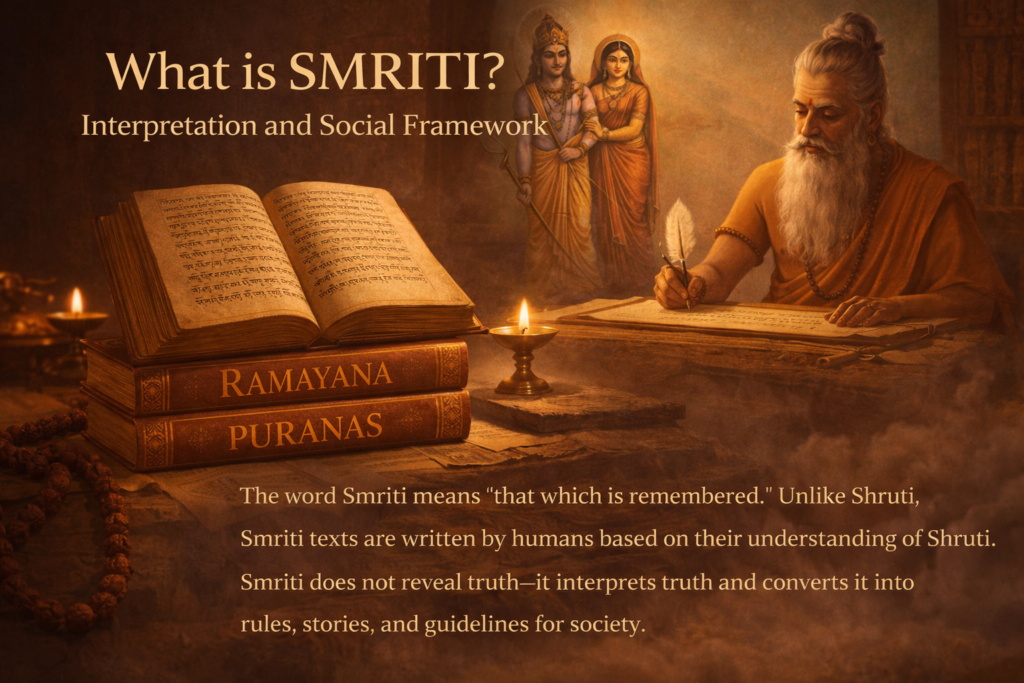
Smriti does not reveal truth—it interprets truth and converts it into rules, stories, and guidelines for society.
Nature of Smriti
- Created by sages and scholars
- Based on interpretation of Shruti
- Focuses on social laws, duties, and behavior
- Changes with time and society
Examples of Smriti Texts
Important Smriti texts include:
- Puranas
- Ramayana
- Mahabharata
These texts are valuable, but they are not absolute truth. They reflect human understanding and societal needs of a particular time.
Core Difference Between Shruti and Smriti
The difference between shruti and smriti becomes clear when we compare their essence.
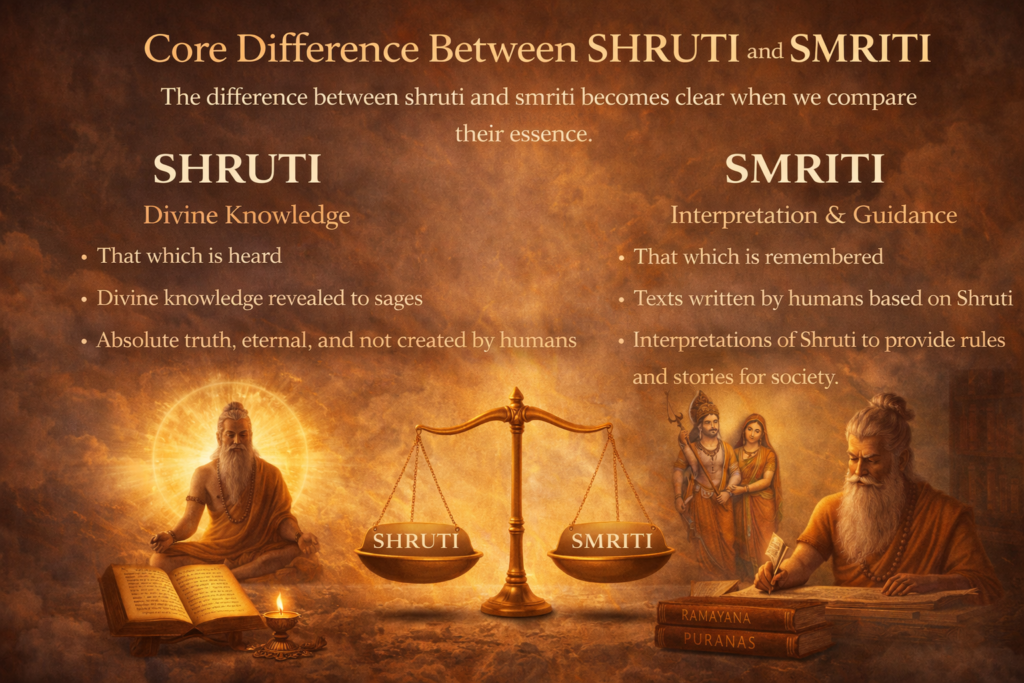
Divine vs Human Origin
- Shruti: Divine revelation (pure truth)
- Smriti: Human interpretation (applied understanding)
Philosophy vs Rules
- Shruti: Focuses on deep philosophy and spiritual reality
- Smriti: Focuses on social rules, duties, and conduct
Authority
- Shruti: Highest authority
- Smrit: Secondary and dependent on Shruti
Permanence
- Shruti: Eternal and unchanging
- Smriti: Flexible and changes with time
Why Shruti is More Important Than Smrit
One of the most important aspects of this topic is understanding why Shruti is superior.
1. Shruti Represents Absolute Truth
Shruti is not influenced by human thinking. It is considered cosmic truth revealed to sages, making it more reliable and universal.
2. Shruti is Pure Philosophy
Texts like the Upanishads deal with profound philosophical ideas such as:
- The nature of reality
- The unity of existence
- Liberation (moksha)
Smriti, on the other hand, simplifies these ideas into practical instructions.
3. Smriti Depends on Shruti
Smriti has no independent authority. Its validity comes from how well it aligns with Shruti.
If a Smriti text contradicts Shruti, Shrut is always accepted as the final authority.
4. Shruti is Universal, Smriti is Contextual
Shruti applies to all times and all people.
Smriti is shaped by culture, society, and historical context.
Shruti vs Smrit in Practical Life
To understand better:
- Shruti tells you what truth is
- Smriti tells you how to live based on that truth
For example:
- The idea of dharma originates in Shruti
- Its application in society is explained in Smriti texts.
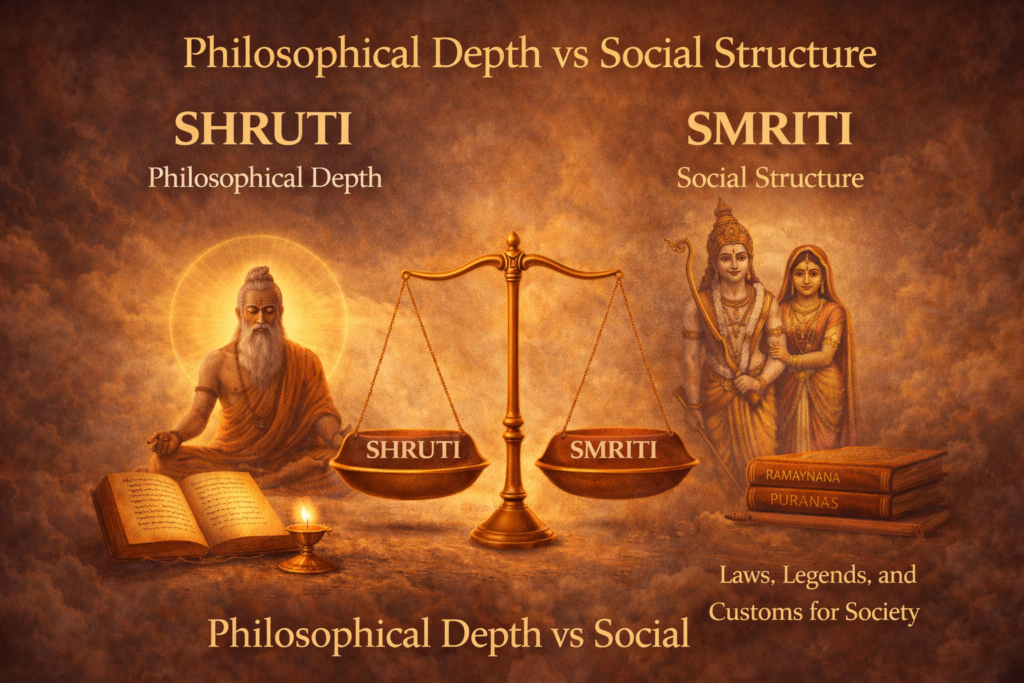
Philosophical Depth vs Social Structure
Shruti: The Foundation of Knowledge
Shruti provides answers to eternal questions:
- Who am I?
- What is reality?
- What is the purpose of life?
Smriti: The Structure of Society
Smriti focuses on:
- Laws and duties
- Social order
- Moral behavior
While important, these are secondary to philosophical truth.
Shruti and Smrit Difference in Literature
Shruti Literature
- Highly philosophical
- Symbolic and spiritual
- Focused on truth and existence
Smriti Literature
- Narrative and explanatory
- Includes epics and law books
- Focused on human life and society
Common Misunderstanding About Shruti and Smriti
Many people think both are equally important, but this is not entirely correct.
- Shruti is primary and supreme
- Smriti is secondary and dependent
Smriti can change, but Shrut cannot. This clearly shows their difference in importance.
Quick Revision: Shruti vs Smriti Difference
- Shruti = Divine, eternal, philosophical truth
- Smrit = Human, changeable, social rules
- Shruti = Supreme authority
- Smriti = Interpretation of Shru
Relevance in Modern Times
Even today:
- Shruti helps people understand spiritual truth and inner reality
- Smriti helps organize society and ethical behavior
However, many Smriti rules may change with time, while Shruti remains constant.
Conclusion
The difference between shruti and smriti lies in their origin, purpose, and authority. Shruti stands as the pure, divine, and philosophical truth, making it the most important source of knowledge in Hindu tradition.
Smriti, although useful, is only an interpretation of Shruti. It translates spiritual truth into social rules and practices, which may evolve over time.
Therefore, Shruti is not just more important—it is the foundation, while Smriti is merely the application.
Understanding this distinction gives deeper insight into Hindu philosophy and helps us appreciate the balance between eternal truth and practical life.
FAQs About Shruti and Smriti
1. What is Shruti and Smriti in simple words?
- Shruti = Divine knowledge heard by sages
- Smriti = Human-written texts based on that knowledge
2. Are Upanishads Shruti or Smriti?
The Upanishads are part of Shruti.
3. Is Bhagavad Gita Shruti or Smriti?
The Bhagavad Gita is considered Shruti because it a part of Upnishadas.
4. What is the main difference between Shruti and Smriti?
The main difference lies in origin and authority—Shruti is divine, while Smriti is human interpretation.
5. Difference Between Shruti and Smriti (UPSC Answer)
The difference between Shruti and Smriti lies mainly in their origin, authority, and purpose:
- Shruti means “that which is heard.” It is considered divine revelation, eternal, and the highest authority. It focuses on philosophy and ultimate truth.
- Smriti means “that which is remembered.” It is written by humans based on Shruti and deals with social laws, ethics, and practical life.
Conclusion (UPSC style):
Shruti is supreme because it is divine and philosophical, while Smriti is secondary as it interprets Shru for societal application.
6. Shruti and Smrit PDF (What to Include)
If you are preparing notes or a PDF, include:
- Meaning of Shruti and Smriti
- Key differences (table format)
- Examples of each
- Importance in Hinduism
- Role in society
- Frequently asked questions
This structure helps in quick revision for exams.
7. Shruti and Smriti Examples
Examples of Shruti
- Vedas
- Upanishads
Examples of Smriti
- Manusmriti
- Ramayana
- Mahabharata
- Bhagavad Gita
8. Shruti and Smriti in Vedas?
- The Vedas themselves are Shruti, meaning they are divine revelations.
- Smriti texts are based on the teachings found in the Vedas but are not part of the Vedas.
9. What is Shruti and Smriti in Hinduism?
In Hinduism:
- Shruti = Divine knowledge revealed to sages (highest authority)
- Smriti = Human-written texts explaining how to live according to Shru
Together, they form the foundation of Hindu religious and philosophical tradition.
10. Upanishads Are Shruti or Smrit?
The Upanishads are part of Shruti.
They are the philosophical section of the Vedas and deal with deep concepts like:
- Brahman (ultimate reality)
- Atman (soul)
- Moksha (liberation)
11. Types of Smriti
Smriti literature can be divided into different categories:
1. Epics (Itihasa)
- Ramayana
- Mahabharata
2. Puranas
- Mythological and historical narratives
3. Niti Shastras
- Texts on ethics and conduct
12. Shruti and Smriti Texts
Shruti Texts
- Vedas
- Upanishads
Smriti Texts
- Ramayana
- Mahabharata
- Puranas
13. Is Ramayana Shruti or Smriti?
The Ramayana is Smriti.
Reason: It is written by the sage Valmiki and presents moral and social ideals based on Shruti principles.
14. What is the Difference Between Shr and Smriti Scriptures?
- Shruti scriptures: Divine, eternal, philosophical (e.g., Vedas, Upanishads)
- Smriti scriptures: Human-made, adaptable, practical (e.g., epics, law books)
Key idea: Shruti is truth, is interpretation.
15. What is an Example of a Shruti?
A primary example of Shruti is the Rigveda, which contains ancient hymns revealed to sages.
Other examples include:
- Yajurveda
- Samaveda
- Atharvaveda
Luôn chơi có trách nhiệm, kiểm soát cảm xúc, tránh tâm lý “gỡ gạc” khi thua. – Đọc kỹ các quy định, chính sách của 66b app trước khi tham gia để bảo vệ quyền lợi cá nhân. – Đảm bảo thông tin tài khoản, giao dịch được bảo mật an toàn. TONY04-28
Chơi tại sportzfy apk old version cảm giác khá ổn định và ít bị đứng máy. TONY07-20