
Why Should We Read Bhagavad Gita
There are books you read once… and then there are books that quietly stay with you for life. The Bhagavad Gita belongs to the second category. It doesn’t just inform you—it transforms you, questions you, and sometimes even unsettles you in the most necessary way.
In a world filled with noise, confusion, and constant pressure to “be something,” the Gita asks a much deeper question: Who are you really?
If you’ve ever felt lost, overwhelmed, or unsure about your purpose, reading the Bhagavad Gita isn’t just a spiritual act—it’s a deeply human one.
Understanding the Essence of the Bhagavad Gita

Before diving into why you should read it, it helps to understand what the Bhagavad Gita actually is.
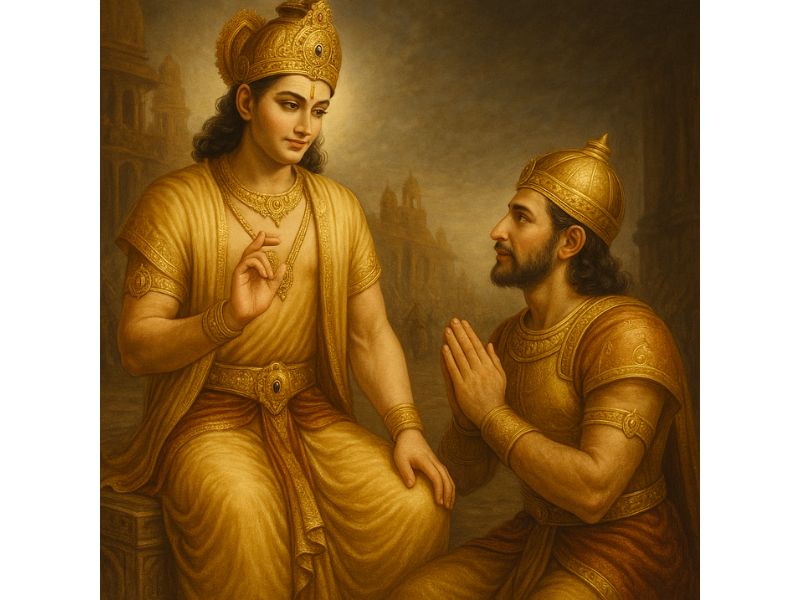
The Bhagavad Gita is a 700-verse dialogue between Lord Krishna and Arjuna, set on the battlefield of Kurukshetra. But don’t let the setting mislead you—this isn’t just a story about war. It’s about the inner conflict we all face.
Arjuna stands confused, emotionally broken, and morally torn. Krishna doesn’t just give him instructions—He gives him clarity.
And that’s exactly what the Gita offers us today.
A Guide to Finding Your Life’s Purpose

One of the biggest reasons people turn to the Bhagavad Gita is to understand their purpose.
We often ask:
- What should I do with my life?
- Am I on the right path?
- Why do I feel unfulfilled even after achieving things?
The Gita doesn’t give you a ready-made answer. Instead, it teaches you how to discover your own path.
It introduces the concept of Dharma—your duty, your role, your unique purpose in life. Not society’s expectations. Not comparison. But your inner calling.
Reading the Bhagavad Gita helps you shift from confusion to clarity.
Learning the Art of Detachment (Without Escaping Life)

One of the most powerful teachings of the Gita is detachment—but not in the way most people misunderstand it.
Detachment doesn’t mean giving up everything or becoming emotionless. It means:
- Doing your best without being obsessed with results
- Loving deeply without fear of loss
- Working hard without anxiety about outcomes
Krishna tells Arjuna to act, but not to cling.
In today’s world, where stress is often tied to expectations, this teaching alone can change how you live your entire life.
How the Bhagavad Gita Helps in Managing Stress and Anxiety
Modern life is full of pressure—career stress, relationship struggles, uncertainty about the future. The Bhagavad Gita addresses all of this, even though it was written thousands of years ago.
It teaches you how to:
- Stay calm in chaos
- Control your thoughts
- Avoid overthinking
- Maintain mental balance
Instead of reacting emotionally to every situation, the Gita trains your mind to respond with awareness.
It’s not just philosophy—it’s mental strength training.
A Practical Guide to Decision-Making

We often struggle with decisions—not because we lack options, but because we lack clarity.
Should I stay or leave?
Should I follow passion or stability?
What if I make the wrong choice?
Arjuna faced a similar dilemma, and Krishna’s guidance offers a framework that is still relevant today.
The Gita teaches:
- How to think beyond fear
- How to act with wisdom, not impulse
- How to align actions with values
It doesn’t remove life’s complexity—but it gives you the strength to navigate it.
The Bhagavad Gita and Self-Realization
Perhaps the deepest reason to read the Bhagavad Gita is this: it helps you understand yourself.
Not your name, not your profession—but your true nature.
It asks questions like:
- Are you your thoughts?
- Are you your emotions?
- Who is the “you” behind all of this?
The Gita introduces the idea of the Consciouness—unchanging, eternal, beyond the physical body.
This realization doesn’t just sound spiritual—it brings a deep sense of peace. Because when you know who you are, the fear of losing things starts to fade.
Why the Bhagavad Gita Is Still Relevant Today
You might wonder—how can a text written thousands of years ago still be useful today?
The answer is simple: human struggles haven’t changed.
We still deal with:
- Attachment
- Fear
- Doubt
- Ego
- Desire
- Confusion
Technology has evolved, but the human mind remains the same.
That’s why the Bhagavad Gita continues to resonate across generations. It doesn’t depend on time—it speaks directly to human nature.
Building Discipline and Inner Strength
Another powerful benefit of reading the Bhagavad Gita is the development of discipline.
The Gita emphasizes:
- Self-control
- Consistency
- Focus
- Inner stability
It teaches that success isn’t just about talent—it’s about mastering yourself.
In a world full of distractions, this lesson is more valuable than ever.
The Balance Between Action and Spirituality
Many people believe that spirituality means leaving worldly life. The Bhagavad Gita completely challenges this idea.
Krishna doesn’t tell Arjuna to walk away from his responsibilities. Instead, He tells him to act—with awareness and wisdom.
This creates a powerful balance:
- You stay engaged in life
- But you don’t lose yourself in it
This is known as Karma Yoga—the path of action with awareness.
It’s not about escaping life. It’s about living it better.
How Reading the Gita Changes Your Perspective
The real magic of the Bhagavad Gita lies in how it changes your perspective.
Situations don’t always change. But your way of seeing them does.
- Failure becomes a lesson
- Success becomes temporary
- Problems become opportunities for growth
Over time, you begin to feel less shaken by external events and more rooted within yourself.
A Source of Inner Peace in a Chaotic World
We often search for peace in external things—money, relationships, achievements.
But the Bhagavad Gita gently reminds you: peace comes from within.
By understanding your thoughts, controlling your reactions, and accepting life’s uncertainties, you begin to experience a calm that isn’t dependent on circumstances.
This is not instant. But it is lasting.
The Bhagavad Gita as a Daily Companion
You don’t need to read the Bhagavad Gita all at once. In fact, it’s more powerful when read slowly.
Just a few verses a day can:
- Give you clarity
- Shift your mindset
- Inspire your actions
Over time, it becomes less of a book and more of a companion—something you turn to when life feels uncertain.
Breaking Myths About Reading the Bhagavad Gita
Many people hesitate to read the Gita because of certain misconceptions.
Let’s clear a few:
“It’s only for religious people”
Not true. The Gita is philosophical and practical, not limited to religion.
“It’s too complex to understand”
While deep, many translations simplify its teachings beautifully.
“It’s only for old age”
In reality, the earlier you read it, the more it helps shape your life.
Why Everyone Should Read the Bhagavad Gita at Least Once
Whether you are a student, a professional, or someone searching for meaning, the Bhagavad Gita has something to offer you.
Helps you:
- Understand life beyond surface-level success
- Handle challenges with maturity
- Develop a strong, clear mind
- Find purpose and direction
It doesn’t ask you to believe blindly. It invites you to think, reflect, and discover.
Final Thoughts: The Journey Within
Reading the Bhagavad Gita is not about becoming someone else. It’s about becoming more of who you truly are.
It doesn’t promise a perfect life. But it gives you the tools to live life with clarity, courage, and peace.
And maybe that’s what we are all searching for—not a life without problems, but a mind that can face them.
So if you’ve ever asked yourself, “What is the purpose of my life?”—the Bhagavad Gita might not give you a direct answer.
But it will guide you to find it yourself.
And that makes it worth reading—again and again.
FAQs
Q1. Disadvantages of reading Bhagavad Gita?
The Bhagavad Gita itself does not have “disadvantages” in the traditional sense, but there are a few misunderstandings that can create confusion:
- If read without proper interpretation, some teachings (like detachment) may be misunderstood as lack of emotion or responsibility.
- Over-philosophizing without applying teachings in real life can lead to inaction.
- Reading it with a rigid mindset may make it seem complex or overwhelming.
In reality, the Gita is meant to guide—not restrict. When read with an open mind and practical approach, it becomes deeply beneficial.
Q2. Benefits of reading Bhagavad Gita for students?
For students, the Bhagavad Gita can be life-changing. It helps in both academic and personal growth:
- Improves focus and concentration
- Reduces exam stress and anxiety
- Teaches discipline and consistency
- Encourages clarity in decision-making
- Builds confidence and emotional strength
It also teaches students to focus on effort rather than results, which is extremely powerful during competitive exams and career decisions.
Q3. Benefits of reading Bhagavad Gita daily?
Reading the Bhagavad Gita daily—even a few verses—can gradually transform your mindset:
- Creates inner peace and mental clarity
- Helps control negative thoughts
- Builds emotional stability
- Strengthens self-awareness
- Encourages a positive outlook on life
Over time, it becomes like a daily mental reset, helping you stay grounded no matter what happens externally.
Q4. Can we read Bhagavad Gita during periods?
Yes, absolutely. There is no restriction on reading the Bhagavad Gita during periods.
Such beliefs come from cultural practices, not from the teachings of the Gita itself. The Gita focuses on inner purity, awareness, and understanding—not physical conditions.
Anyone can read it at any time, regardless of circumstances.
Q5. What happens if we read Bhagavad Gita?
Reading the Bhagavad Gita regularly leads to gradual but powerful changes:
- You start thinking more clearly and logically
- Emotional reactions become more controlled
- You gain a deeper understanding of life and purpose
- Fear, anxiety, and confusion begin to reduce
It’s not an instant transformation—but over time, it reshapes how you see yourself and the world.
Q6. Miracles of reading Bhagavad Gita?
The “miracles” of the Bhagavad Gita are not supernatural—they are internal transformations:
- Sudden clarity in confusing situations
- Increased calmness in stressful moments
- Better decision-making abilities
- A sense of purpose and direction
These changes may feel miraculous because they shift your inner world so deeply, but they come from understanding and applying its wisdom.
Q7. Can we read Bhagavad Gita on bed?
Yes, you can read the Bhagavad Gita on bed. There are no strict rules about posture or place.
However, from a practical perspective:
- Sitting in a focused posture may improve concentration
- Reading with attention and respect enhances understanding
The key is not where you read, but how mindfully you read.
Q8. Why is the Bhagavad Gita so powerful?
The Bhagavad Gita is powerful because it addresses universal human struggles:
- It explains how to deal with fear, doubt, and confusion
- It provides practical guidance for real-life situations
- It combines philosophy with actionable wisdom
Its teachings are timeless because they focus on the human mind and inner conflicts, which remain the same across generations.
Q9. Is Lord Krishna real or myth?
This question has both philosophical and historical perspectives:
- Many believe Lord Krishna was a real historical figure mentioned in ancient texts like the Mahabharata
- Others see Krishna as a symbolic representation of higher consciousness or divine wisdom
Regardless of belief, the teachings given by Krishna in the Bhagavad Gita hold deep philosophical value and practical relevance.
Q10. What are the six sins of the Bhagavad Gita?
The Bhagavad Gita often highlights inner enemies (sometimes referred to as “sins” or negative tendencies) that disturb human life. These are commonly understood as:
- Lust (Kama)
- Anger (Krodha)
- Greed (Lobha)
- Delusion or attachment (Moha)
- Pride (Mada)
- Jealousy (Matsarya)
The Gita teaches that overcoming these tendencies is essential for inner peace and self-realization.